
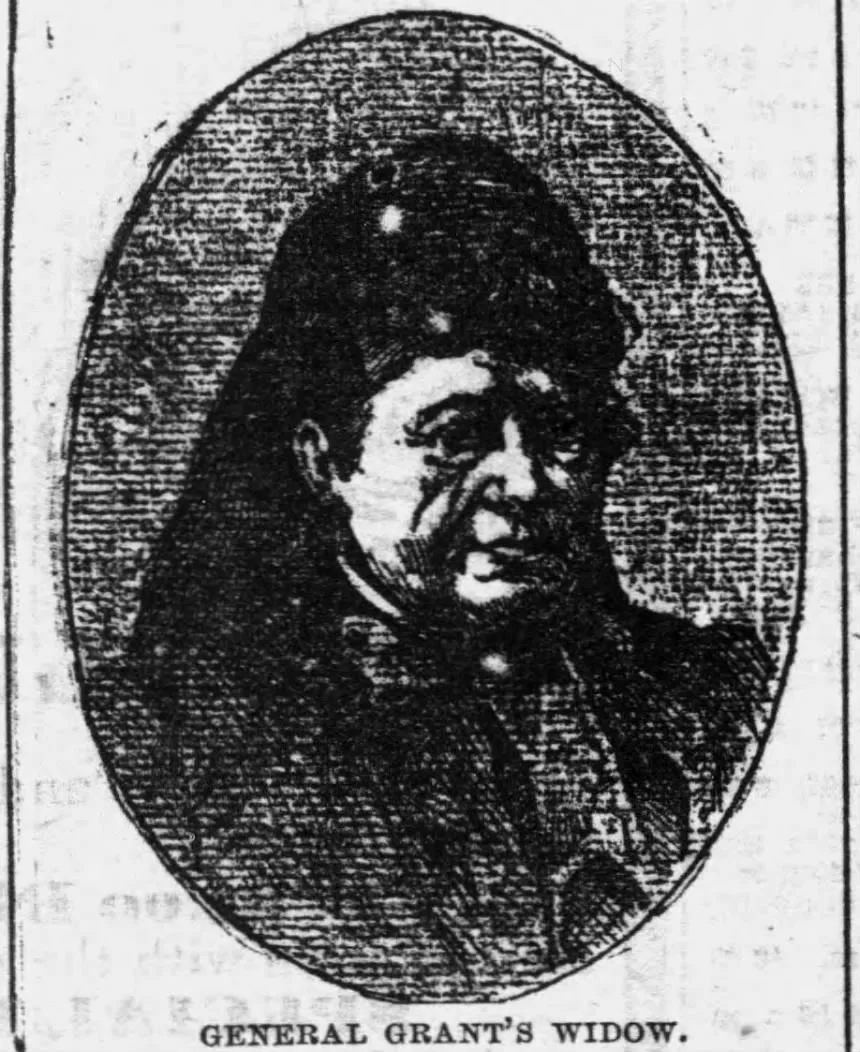
In the weeks following the death of Ulysses S. Grant in 1885, the United States was engulfed in a period of national mourning. All attention had been focused on the famous American as he struggled against terminal illness to finish his memoirs for his family. His story had unfolded in front of the public in the form of detailed newspaper coverage. After his death, newspapers ran lengthy articles on his life, and the public interest in his life and career reached an absolute fever pitch. There was an intense interest in all aspects related to the funeral and mourning. Attention also focused on the principal mourner of all. A torrent of condolences descended upon Grant’s widow, Julia, from all over the world. These sentiments did little to reduce the sting from her great loss. She was forced to not only process the loss of her beloved husband, but was also obligated to meet the mourning customs of the period.
Julia had always been very close to her husband ever since their meeting some 40 years before. Ulysses hated to be away from her and the family, and forced periods of separation were some of the hardest things they had to endure during their unfaltering and loving relationship. Through financial hardship, wars, and political office, she stood steadfastly by his side, providing the encouragement and advice he needed. In the final trying months, she sat bravely by his side to the last breath in the parlor of the cottage on Mt. McGregor. His final letter to her, found in his pocket, expressed his hope they would be reunited in “another, and I trust, better world,” a letter to which she wrote a private response, which was placed with his remains along with a lock of her hair.
As the newspapers brimmed with talk of memorials, remembrances, funeral exercises, and the like, Julia sought privacy in the refuge of her room on the second floor of the cottage. She had endured the loss of her parents and a brother, but Ulysses had been by her side through those periods of grief. Julia later described the feeling of loss: “he, my beloved, my all, passed away, and I was alone, alone.” A swirling mix of emotion and memory descended on the tired widow, strained from months of restless anxiety. Grief would be her burden to bear, as it is for everyone who loses a loved one. She and her husband had fully appreciated the struggles of widowhood, with so many young husbands lost to the Civil War. They gave personal funds to support widows and orphans, and President Grant supported legislation to provide for them. In 1879, the couple attended a fundraiser for the Widows' and Orphans' Aid Association of the San Francisco Police Department.
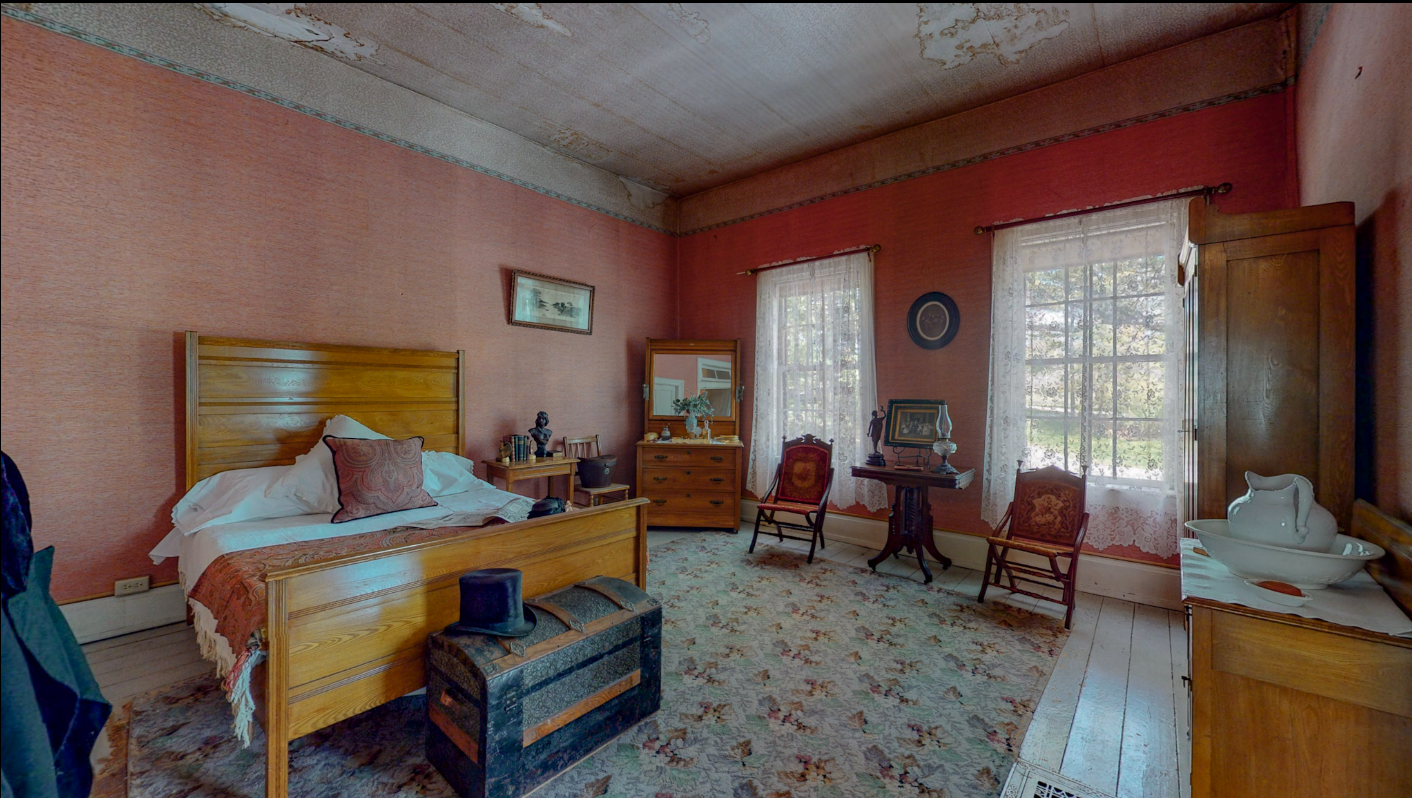
A second floor room at Grant Cottage featuring some original 1885 furniture.
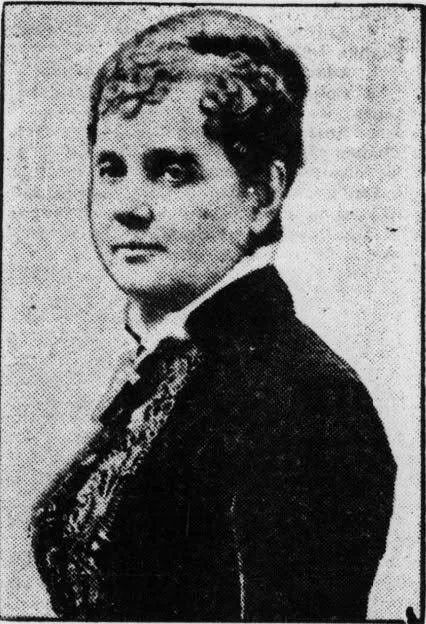
Angeline Newman
As the necessary work of preparing her husband’s remains went on below among the many bouquets of fragrant flowers, family and friends attempted to comfort her. One of those who provided much-needed emotional support was Angeline Newman, the wife of Reverend Philip Newman, whose friendship with Julia had been a mainstay during her husband’s illness. Julia later recalled the crucial support of the Newmans: "Their sympathy and spiritual consolation was a great comfort… Shall I ever forget the kindness and sympathy of my dear friends Bishop and Mrs. Newman?" The crippling grief of those early days kept her from venturing far from her room as newspapers published alarming reports that her health was suffering and she might “not long survive her husband.”
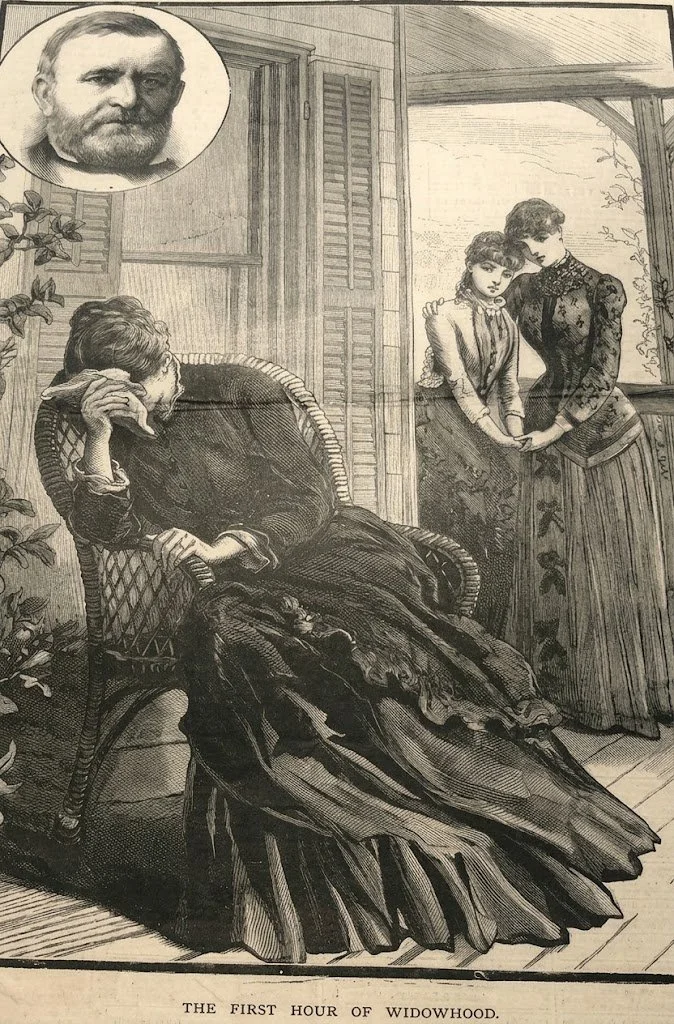
A dramatized image of Julia mourning her husband. From the National Police Gazette - Aug. 1, 1885
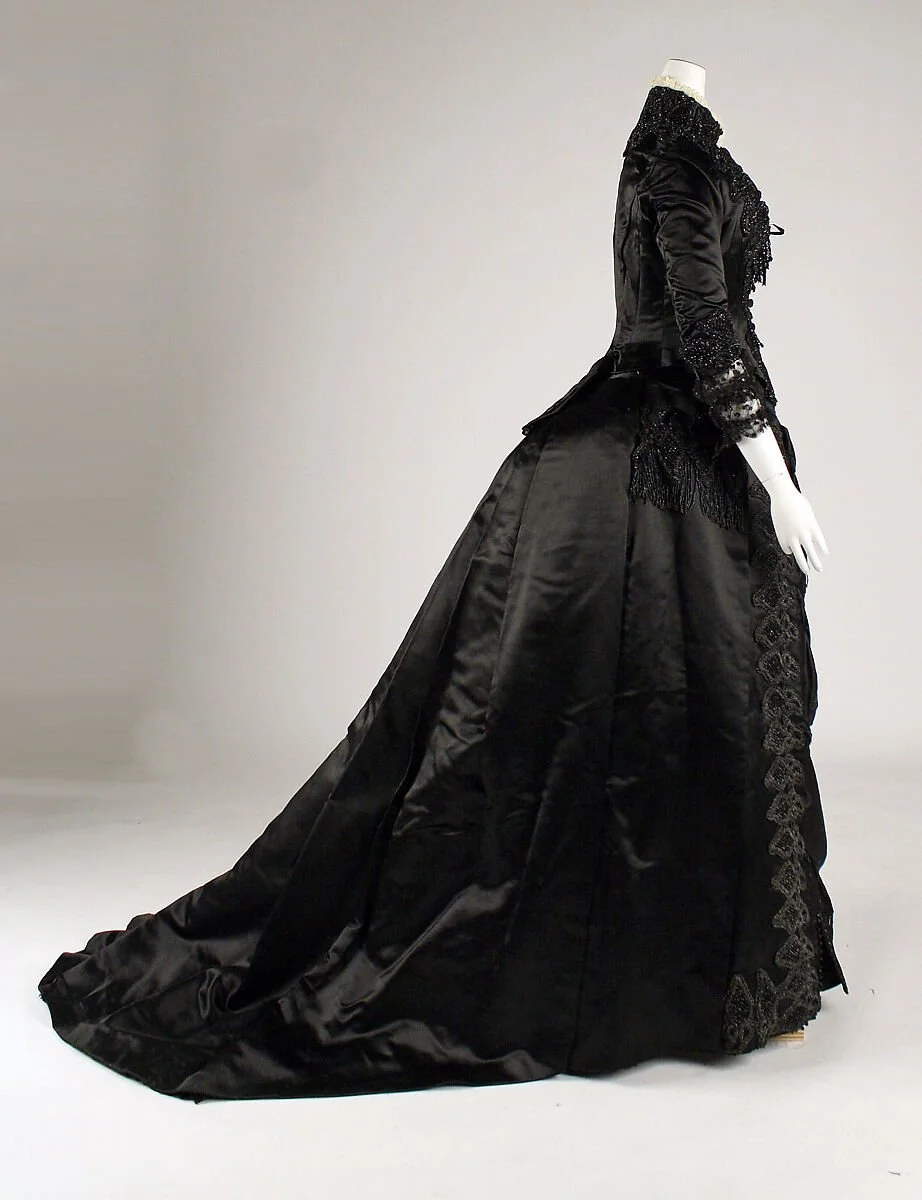
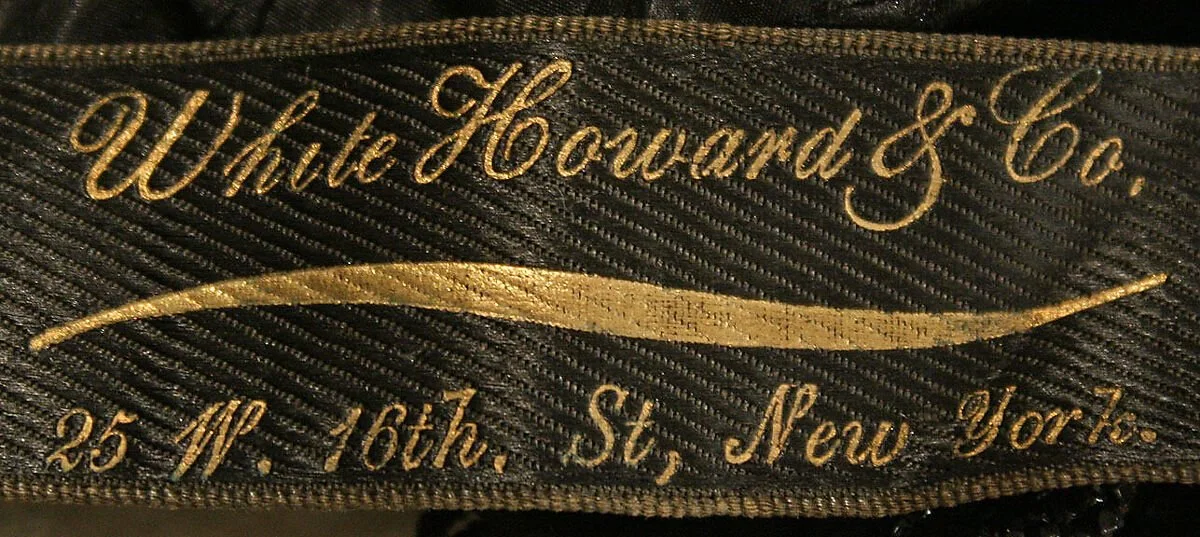
Julia’s son Fred was overseeing most of the family affairs and funeral arrangements, but consulted his mother when necessary. In addition to being consulted on funeral matters, there were certain mourning customs for widows which Julia was forced to attend to. Queen Victoria of England lost her husband in 1861 and set a precedent by wearing black garments (“Widows Weeds”) for the remaining years of her life. Widows were expected to be in a period of mourning for up to two years, with customs dictating their social activities, correspondence, and attire. Though she was an avid shopper and enjoyed discussing dresses and dressmakers with her friends, Julia now had the unenviable task of choosing clothing that symbolized loss. The newspapers recorded that the Grant family ladies ordered their mourning dresses, clothing, and accessories (hats, jewelry, gloves, parasols, etc.) from the prominent New York City clothing firms of White, Howard, & Co. and Lord & Taylor. Julia wanted her dress “plain and tasteful,” and it was described as follows:
““Mrs. Grant’s dress will be of heavy black Henrietta cloth. The skirt will be perfectly plain, with broad bands of crape around the bottom. The overskirt will be simply draped, high on the left side and bordered with crape, which hangs in graceful folds to the bottom on the right side. The bodice will be a postillion jacket, with a fichu of crape in front, which will finish at the throat with a small bow. The sleeves will be long and have cuffs to match the bodice. The bonnet will be a small poke covered with crape, and the veil will be made long and will cover the entire dress.” ”
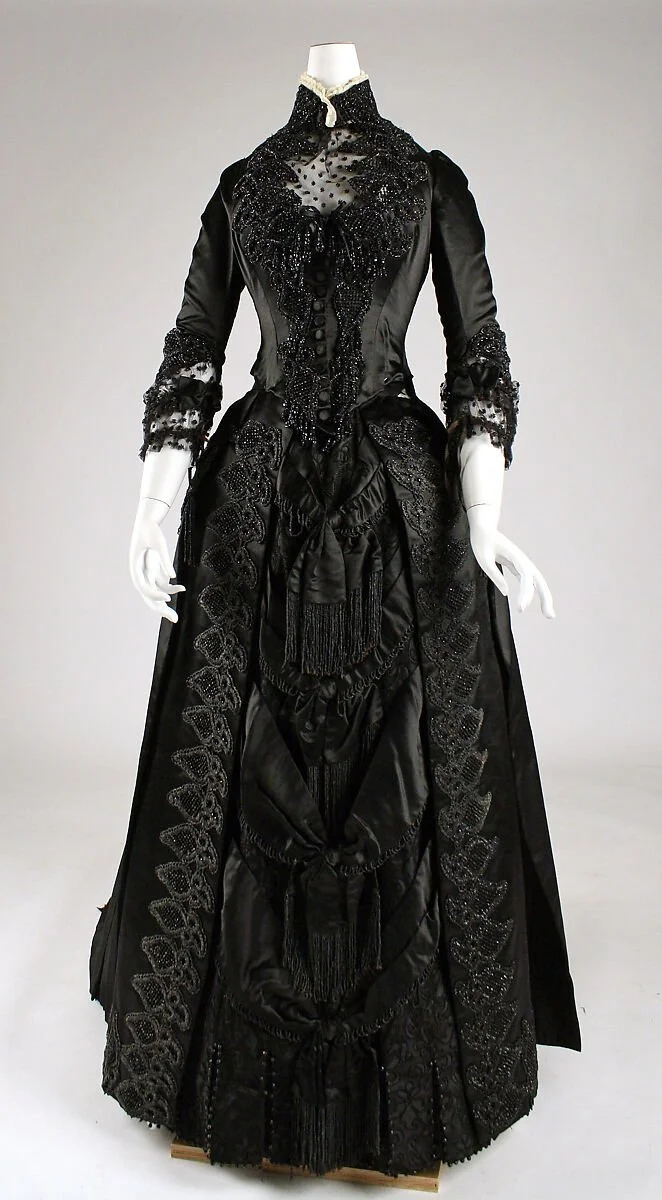
1887 Mourning Dress by White, Howard, & Co. (Source: Metropolitan Museum of Art)
On July 29th, the casket arrived, and General Grant was placed within it. Julia decided to descend to the flower-filled parlor to view the remains lying under the catafalque with floral tributes nearby. Julia was now surrounded by symbols of mourning as the preparations for the memorial services were progressing on the mountain, with the cottage and funeral railroad car being decorated with black fabric. Julia would visit the casket multiple times over the ensuing days, processing her grief. At certain times, the public was admitted into the parlor to pay their respects under the watchful eye of the Civil War veteran guards. Julia eventually felt up to the task of participating in the decorating, draping her husband’s leather chair “artistically… with mourning cloth.”
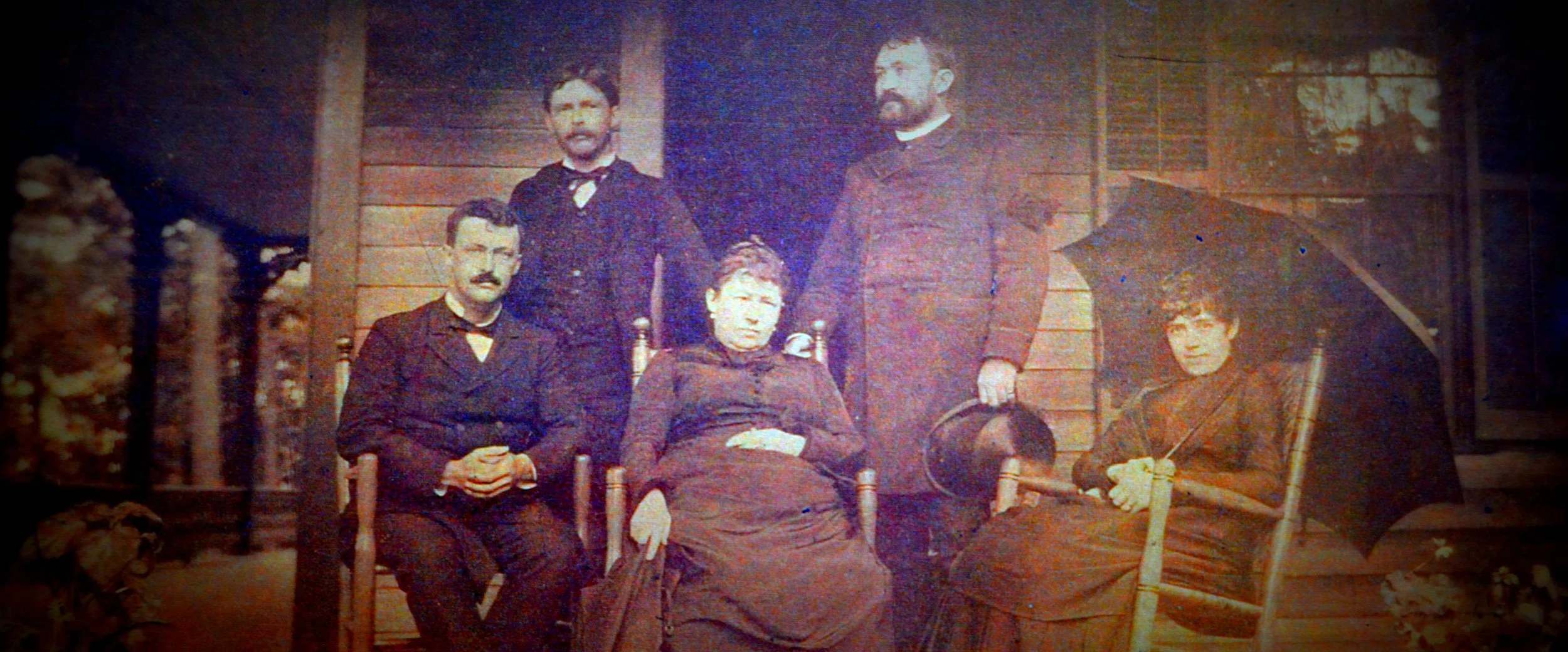
As the day set for the memorial service drew near, the mountain began to fill with military tents and equipment. A martial scene that perhaps evoked memories for Julia of visiting her “Victor” at the warfront twenty years before. August 2nd was Sunday, the Sabbath. Julia had rested on her Methodist faith throughout her life, and realizing it was her last opportunity for a private prayer service, she called for Reverend Newman. The family knelt in prayer, and Bible verses were read. This seemed to ease Julia from the shock of loss and prepare her to say goodbye. A photograph was taken on the cottage porch and is believed to have been taken after Grant’s death, showing the family surrounding their mother. What appear to be mourning bands, customary mourning attire for men, are visible on the left arms of both of her sons, Ulysses Jr. and Fred.
It fell to Julia to make the decision on a final resting place for her late husband. Unfortunately, there was controversy almost immediately regarding her choice of Riverside Park in New York City. Many believed Washington DC to be a more appropriate location as he was a hero of the nation. Julia and the family were not swayed, with the assurance of a place of rest for Julia beside her husband guaranteed by the New York authorities. Ulysses had expressed to her his desire to rest together when they visited the sarcophagi of King Ferdinand and Queen Isabella in Spain on their world tour. Sharing a tomb would honor the final wishes of her husband and be a lasting symbol of their bond beyond the grave.
Though Julia did not attend the New York City funeral, instead staying at the cottage with Mrs. Newman, she would make frequent visits to her husband’s tomb in Riverside Park over the ensuing years. Flowers were important symbols of remembrance and mourning, and the tomb would be the site of many floral tributes around Decoration Day (Memorial Day). Julia would be admitted inside and would lay white roses on the steel casket, a reverent symbol of peaceful mourning.
Julia spent her latter years with family and friends. She would gradually start to accept invitations to social events, some honoring her late husband. She spent the summer of 1887 at the Long Branch, NJ, cottage, where she kept a “widow’s first tribute to memory”:
“On an antique cabinet… is a bust in plaster of the brave old soldier… Behind it hangs a wreath of white immortelles… with a circlet of white ribbon still clinging to it, typical of wedded love. A slender glass filled with geraniums… Every morning this tiny bouquet is gathered… by the lonely wife who kisses the blossoms and tenderly places them before the face of her hero. The faded flowers are dried and, mixed with their own fragrance, go to make those memory-bags so highly prized by the friends on whom they are bestowed.”
Her role as a widow of the famous Hero of the Union became solidified, and she fully accepted it. She used her prominence to advocate for the support of war widows in an article in Harper’s Bazaar in 1900 during the Philippine-American War, requesting a relief fund and college scholarships for war orphans:
“What, too, of the women who have no more to wait for, who sit no longer at the window of hope, they, from whom war’s cruel avarice has robbed all that life held dearest—the widowed wives... Many of them are scattered through our land today… who… are bravely trying to catch up the broken strands, and out of the changed conditions are doing the best they can for themselves and their little ones…”
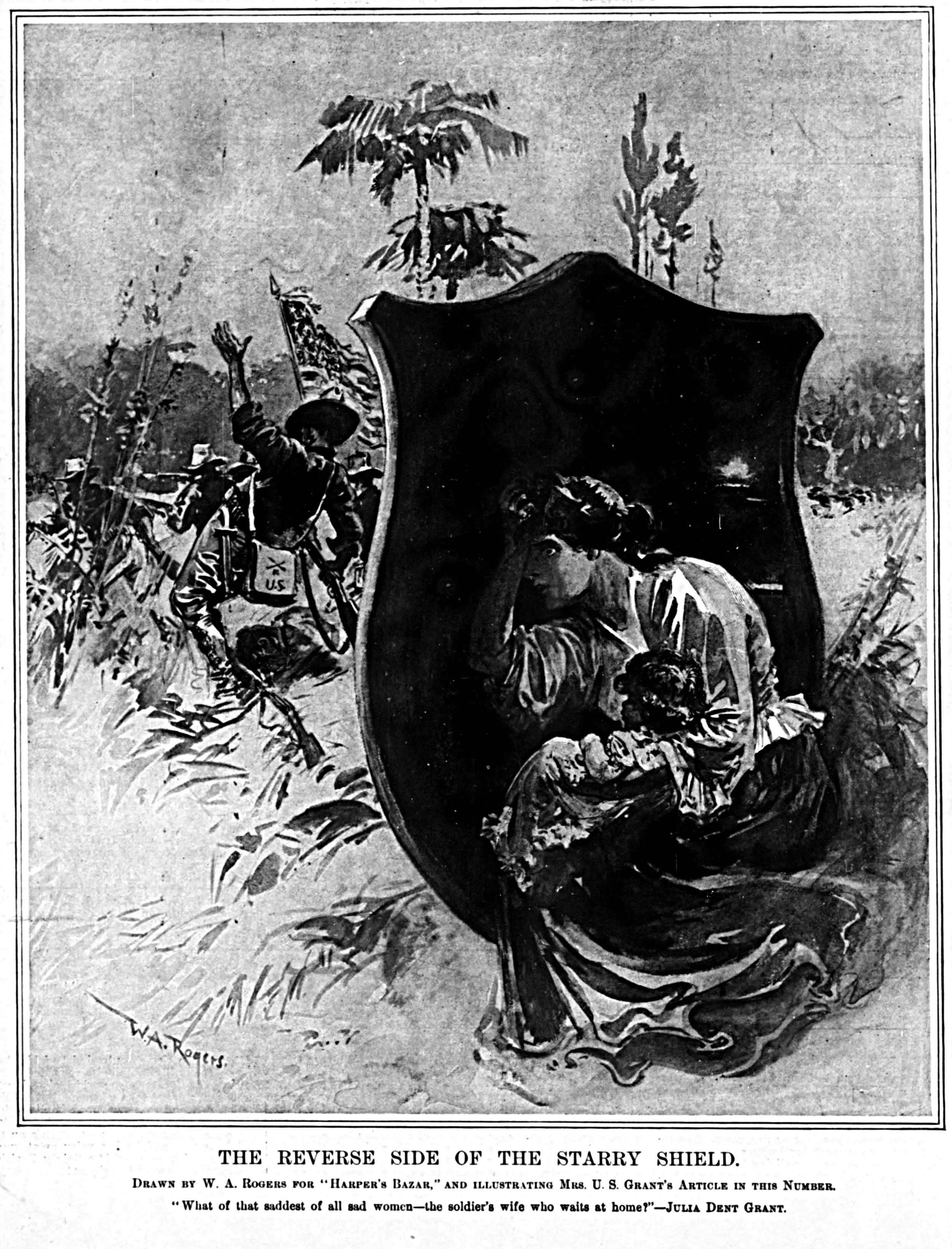
Illustration of a military wife from Harper’s Bazaar 4/21/1900
It was very obvious that her late husband was still adored by the nation when their permanent tomb was dedicated on a cold, breezy April day in 1897 in front of massive crowds. The people also celebrated her, cheering when her carriage passed in the procession. Julia, surrounded by family, sat on the viewing stand dressed all in black, wearing blue-tinted glasses, and stated that she was proud “to have realized that he is today as keenly alive in the memory of the American people as he will be for all time in my heart…” She held his memory dear for 17 years until it was her time to join him in a “better world” in 1902. Julia was far from jealous of her husband’s fame and believed it was well deserved. In her memoirs, she expressed her personal widowhood experience in the final paragraph:
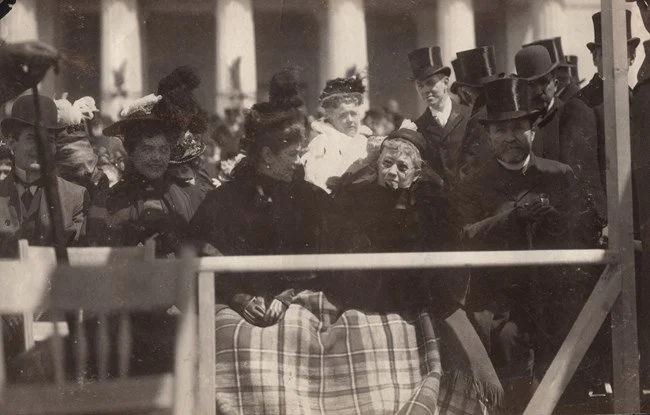
Julia Grant (wearing blue tinted glasses) with family at the dedication of the Tomb on April 27, 1897.
“For nearly thirty-seven years, I, his wife, rested and was warmed in the sunlight of his loyal love and fame, and now, even though his beautiful life has gone out, it is as when some far-off planet disappears from the heavens; the light of his glorious fame still reaches out to me, falls upon me, and warms me.”
Sources:
The Captain Departs by Thomas Pitkin
The General’s Wife by Ishbel Ross
The Personal Memoirs of Julia Dent Grant
Around the World with General Grant by John R. Young
The Papers of Ulysses S. Grant
The Indianapolis Journal - 7/26/1885
The Indianapolis Journal - 8/10/1887
Oakland County Advertiser - 9/22/1887
Harper’s Bazaar - 4/21/1900